Planet Uncanny
[2025]
Various Materials
Planet Uncanny
[2025]
Various Materials
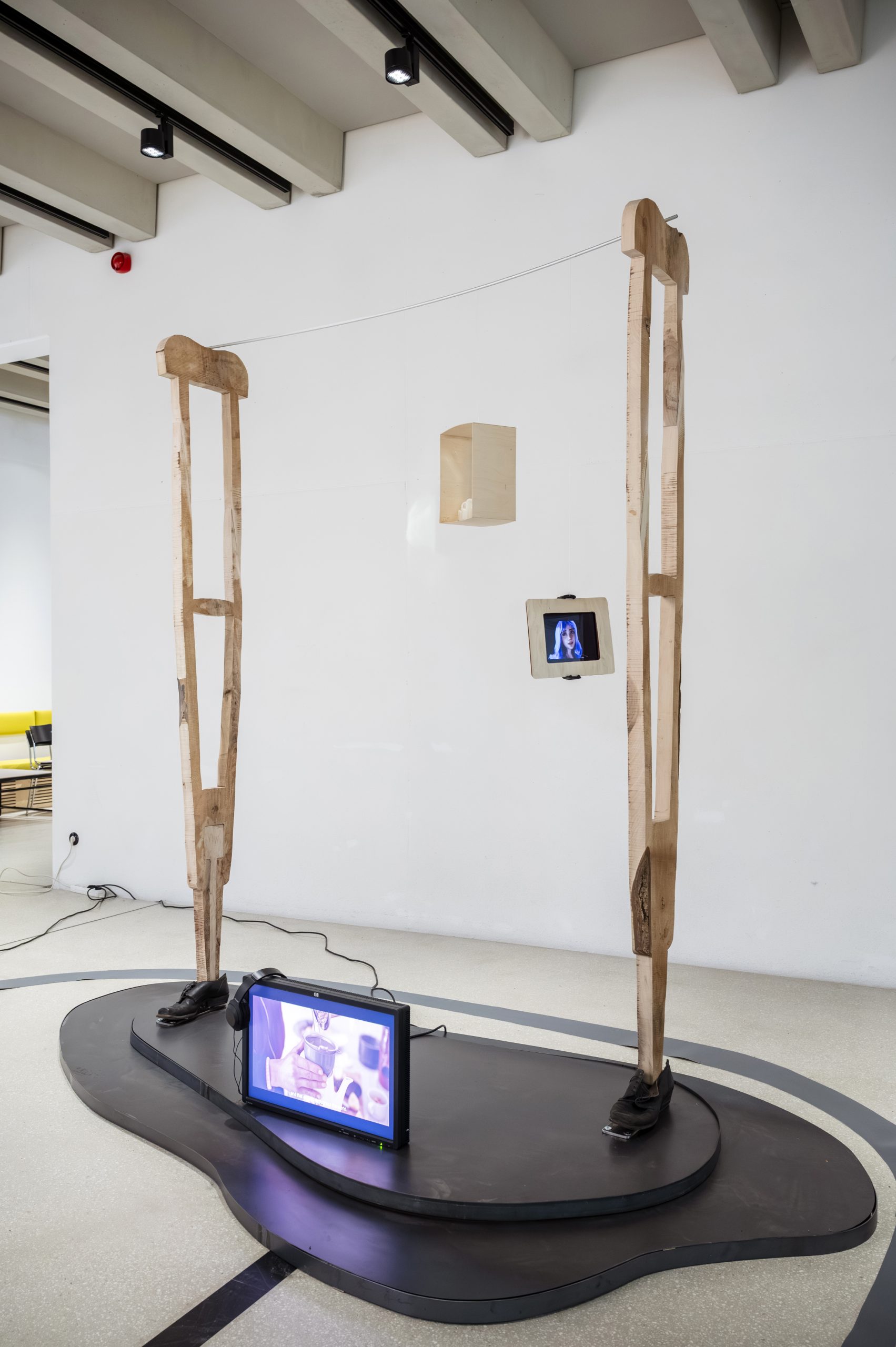
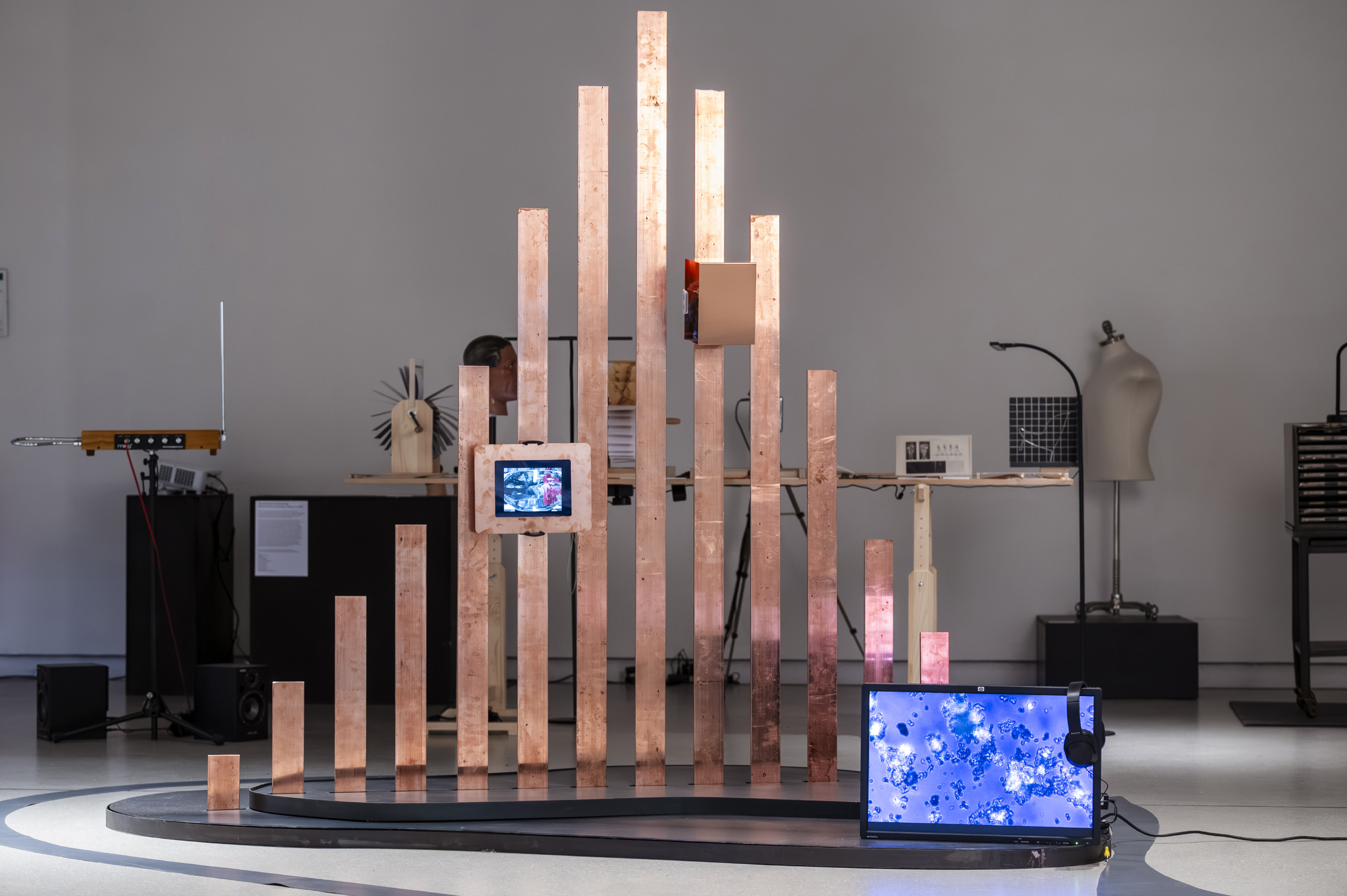
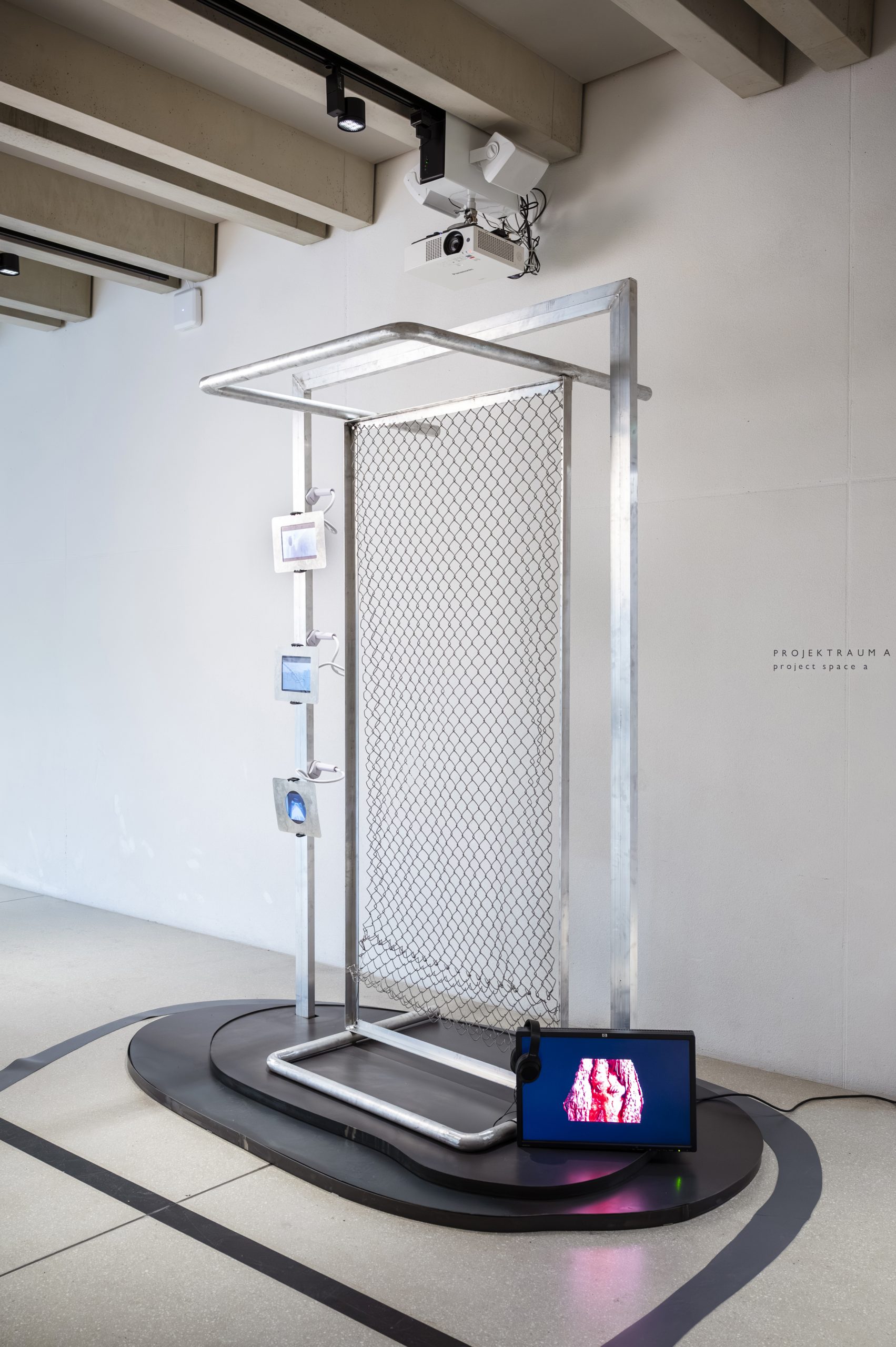
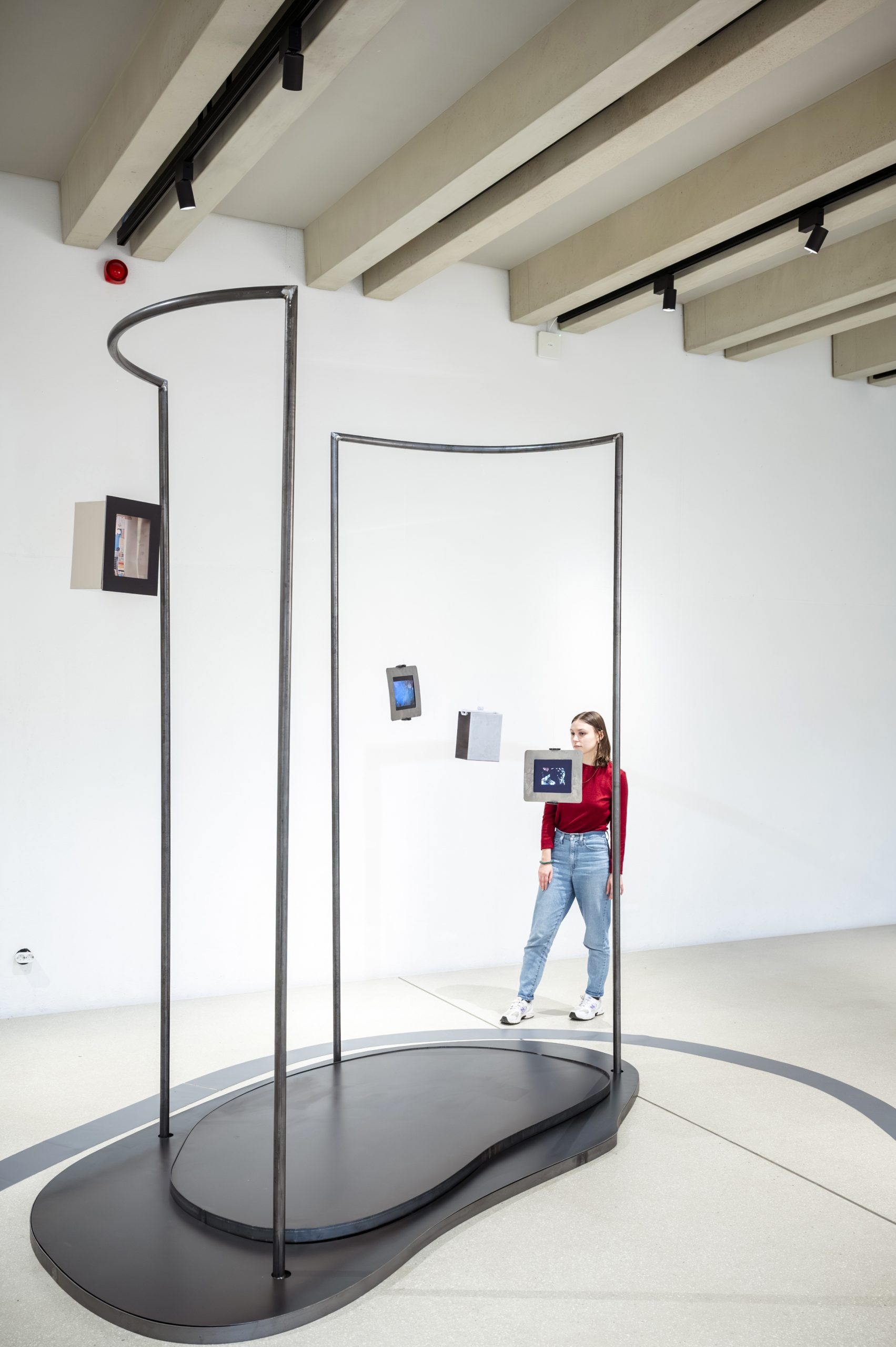
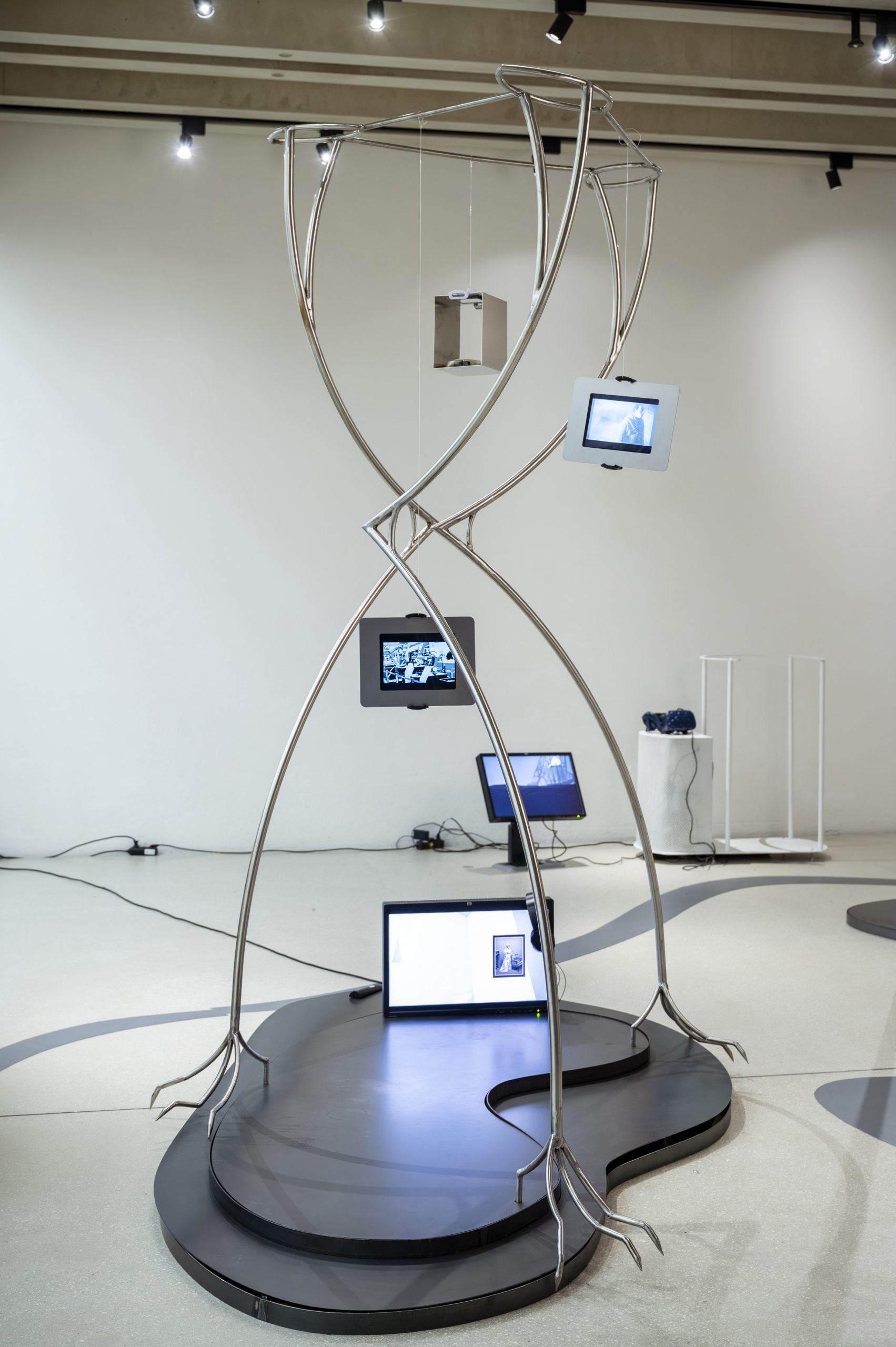
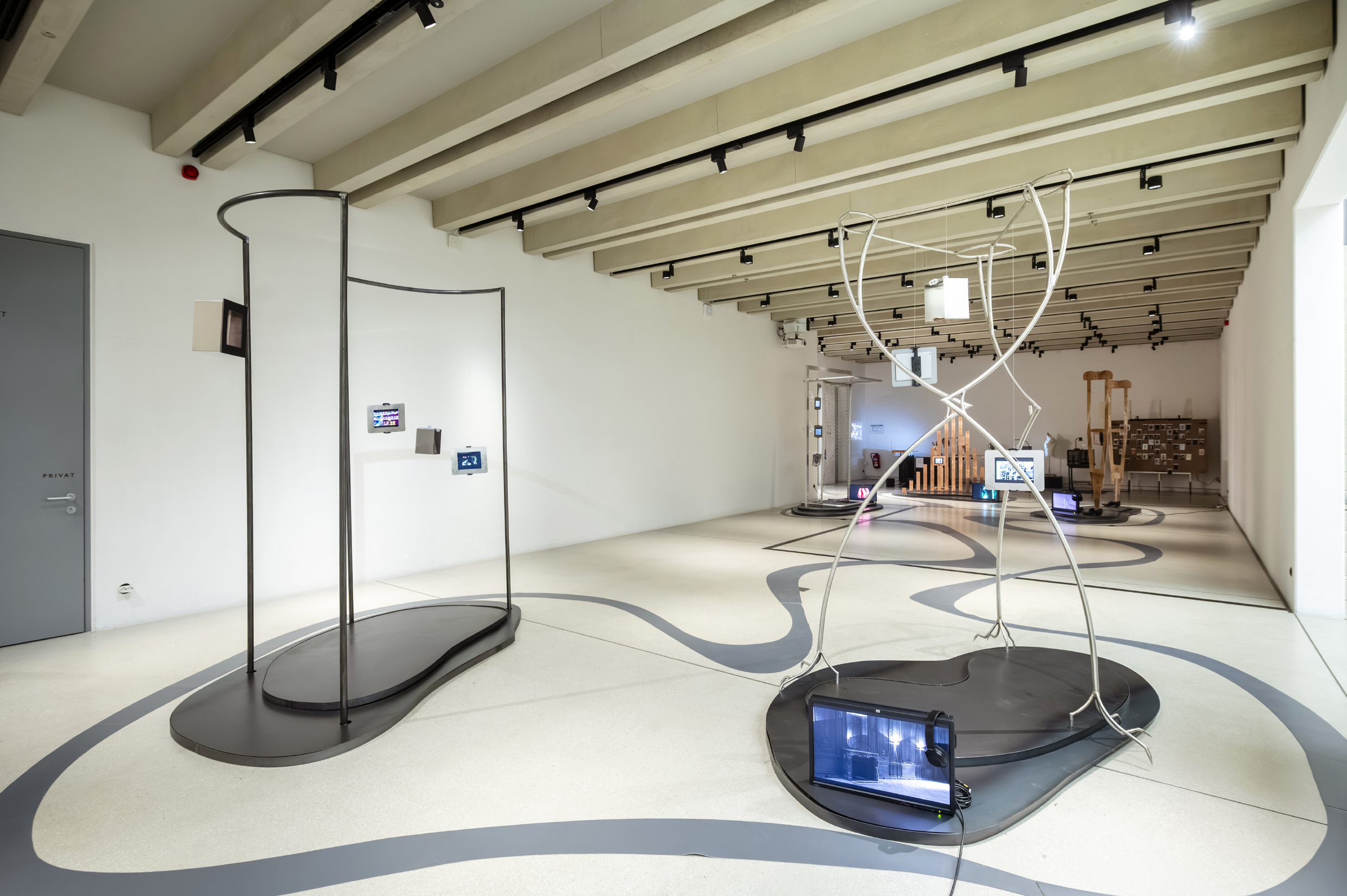
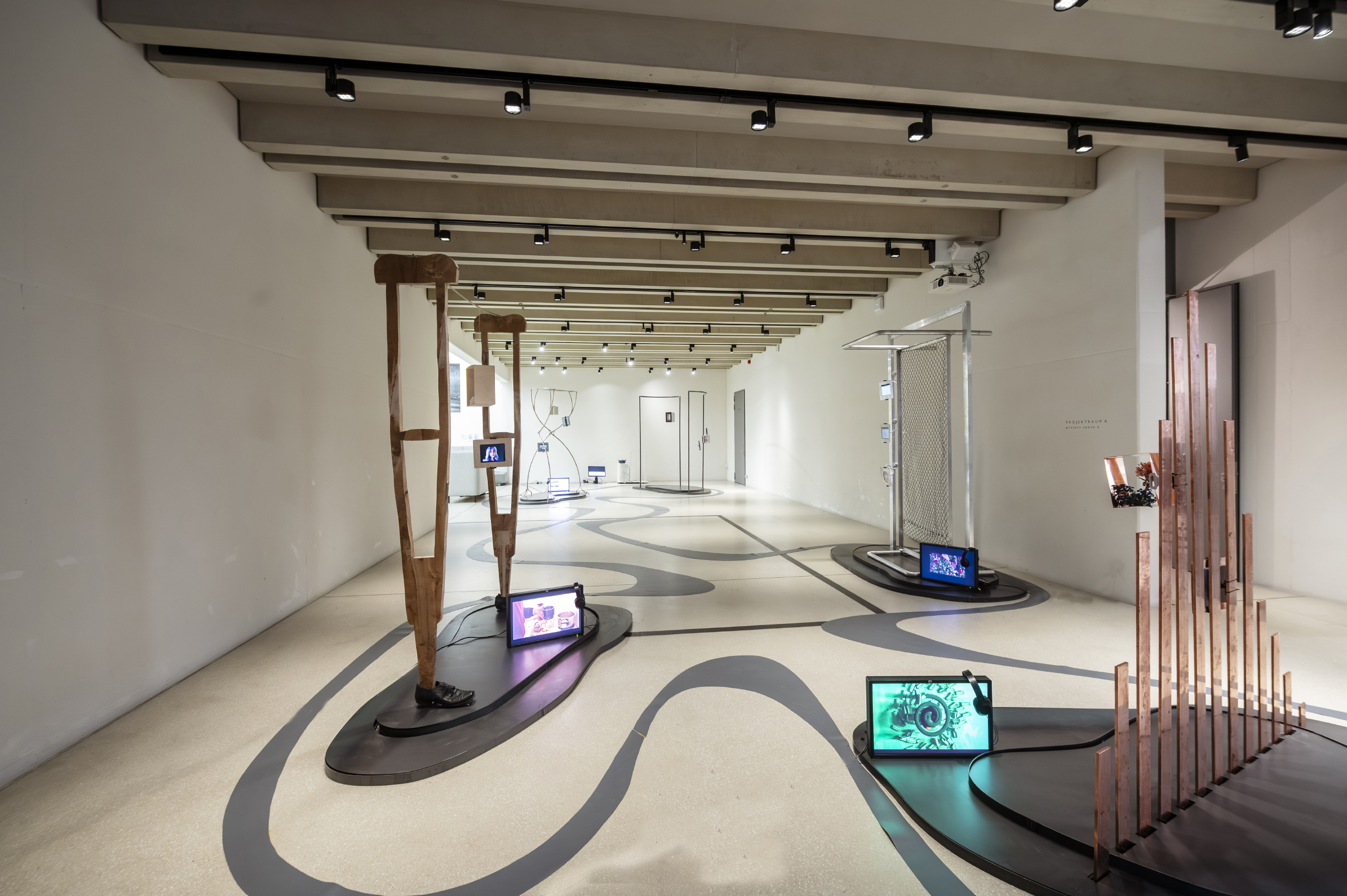
As part of the conference “Planet Uncanny: Redistributing Subjectivities across Technology, Nature, and Society,” Jenny Brockmann (*1976) has created a spatial installation which artistically reflects the thematic blocks of the scientific examination of the uncanny, framing the individual lectures and providing a spatial setting for them. The aim is to promote mutual enrichment and a more holistic view of the uncanny beyond the usual boundaries and attributions of disciplines by juxtaposing varying perspectives in scientific and artistic approaches and allowing them to comment on each other. Brockmann has divided the Bauhaus Museum’s project space into five plateaus grouped around a so-called “valley.”Each plateau is assigned to an aspect of the uncanny with reference to the psychoanalyst Sigmund Freud and his 1919 essay “The Uncanny.” Based on Freud as well as with updated theories from various disciplines that deal with the uncanny and its effects on subject formation, Brockmann explores the uncanny in an artistic way. The individual islands deal with the thematic blocks of imagination, repetition, substitution, divination, and transition, which also structure the panels of the conference participants. Based on my previous experiences and information about the installation, the considerations that follow are based on the assumption that the interplay of art and science in this format will largely be based on the creation of a (spatial) atmosphere that will be differently designed within the five theme-related plateaus.
The concept of the uncanny cannot be clearly defined, but rather various different experiences, encounters, or situations are perceived as uncanny owing to individual, subjective, and cultural influences;it therefore makes sense to open up the form of a conference to different ways of knowing and thinking using artistic means. Just as Freud sought to distinguish the uncanny from the terrifying or fear-inducing, subordinating feelings of the uncanny to the fearful but not defining them, Brockmann also uses this blurring or openness for her explorations, following on from her previous artistic practice in which she builds bridges between scientific approaches and aesthetic explorations. With her installation, which hosts the lectures and discussions within the conference, she thus experiments with bringing together different modes of perception and presentation. In doing so, primarily cognitively designed modes of understanding and communication are juxtaposed with different, more associative modes of penetration. While the conference participants sit in the “valley” between the raised islands, the speakers position themselves on or in front of one of the islands, thus occupying an exposed position in multiple senses, framed or commented on by the artistic work as they speak. The underlying idea of this spatial arrangement is to flank theoretical knowledge with spatial experiences, exemplary visualizations, symbolic objects, and cinematic (everyday) explorations. In this setting, the acceptance gap of the near-perfect “uncanny valley” is linked to considerations of Freud’s theory of the uncanny and brought up to date.
Whereas, in some of her earlier works, Brockmann constructed quasi-experimental communicative encounters or experiences, here she seems to be exploring the boundaries of knowledge using symbolically charged forms and accumulations of different objects and artistic works within the communicative conference situation. Not least, this raises the question of what we understand by artistic research and what significance we attach to aesthetic experiences in the production of knowledge. Moments of translation or transfer of theoretical concepts, everyday knowledge, and cultural-historical references in artistic works, which are intended to frame the conference and thus the joint reflection and presentation of one’s own lines of research, shape the examination of the uncanny. While Brockmann draws on various systems of cultural representation and knowledge processing, from borrowings from a collection toan archive, a cabinet of curiosities, and cinematic representations, the references and allusions stand relatively equally alongside each other. As in the initial stages of scientific research involving the examination of materials, such as literature reviews of the state of research, data, or observations collected by oneself or others, Brockmann does not draw any direct conclusions, but allows the assemblages to take effect in the space. The aim is not to verify a thesis or arrive at a scientific narrative, but rather to allow the objects, borrowings, associations, and individual artistic works to remain in a space of polyphony. Upon closer inspection of the individual parts of the installation, different paths emerge; these do not form a coherent whole, they rather maintain a perspective with varying possible cross-connections. With her large-format sculptural installations made of steel, aluminum, wood, and copper, which carry, hold, or frame her earlier works, as well as various found objects, all of which are occasionally slightly elevated in the space, Brockmann evokes physical modes of experience. Together with the materials, forms, and contents, the fields of meaning are intended to create an atmosphere in the space that will inform thinking and debate during the conference. In doing so, she focuses in particular on the disjointed and surreal. In the installation, the rhythms of the conference are spatially structured in their chronologically organized structure and subjected to movements of physical reorientation on the part of the listeners in order to evoke a more embodied perception.
These shifts in the ways of perceiving the conference, as well as in the perspectives on and locations within the concrete space of thought, unite the various aspects of understanding and negotiation processes which are particularly embodied here,. With her installation, Jenny Brockmann explores intermediate areas in which the familiar is made partially unfamiliar in order to approach perceptions of the uncanny.
Text by Julia Katharina Thiemann